 Claude Code
 Cursor
 Codex
Codex
 Zed
Any MCP client
Terminal
Zed
Any MCP client
Terminal
Your AI already writes the code. Now it knows exactly what to change.
Every note you point-and-speak lands in the tool you already use — the exact element, your words, and the screenshot, together. No more "which button did you mean?" Your agent gets the real target and gets to work.
Works with the tools you already use
Claude Code, Cursor, Codex, Zed, the terminal — if it speaks MCP, it pulls your notes straight in. One command to connect. Nothing to configure.
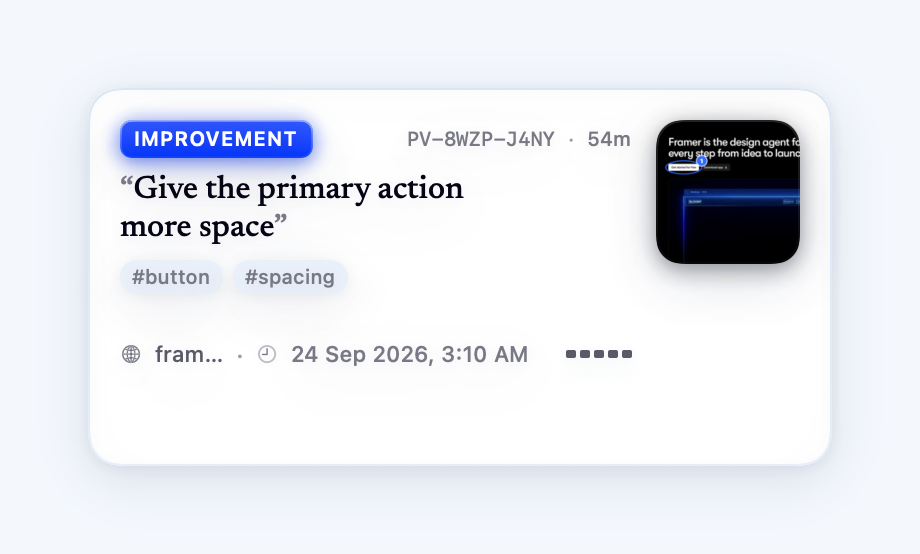
It grabs the exact thing you pointed at
Not "somewhere on the screen" — the actual button, field or row, with your words and the screenshot attached. Your AI never has to guess what you meant.
Catch the thought.
Keep the next step close.
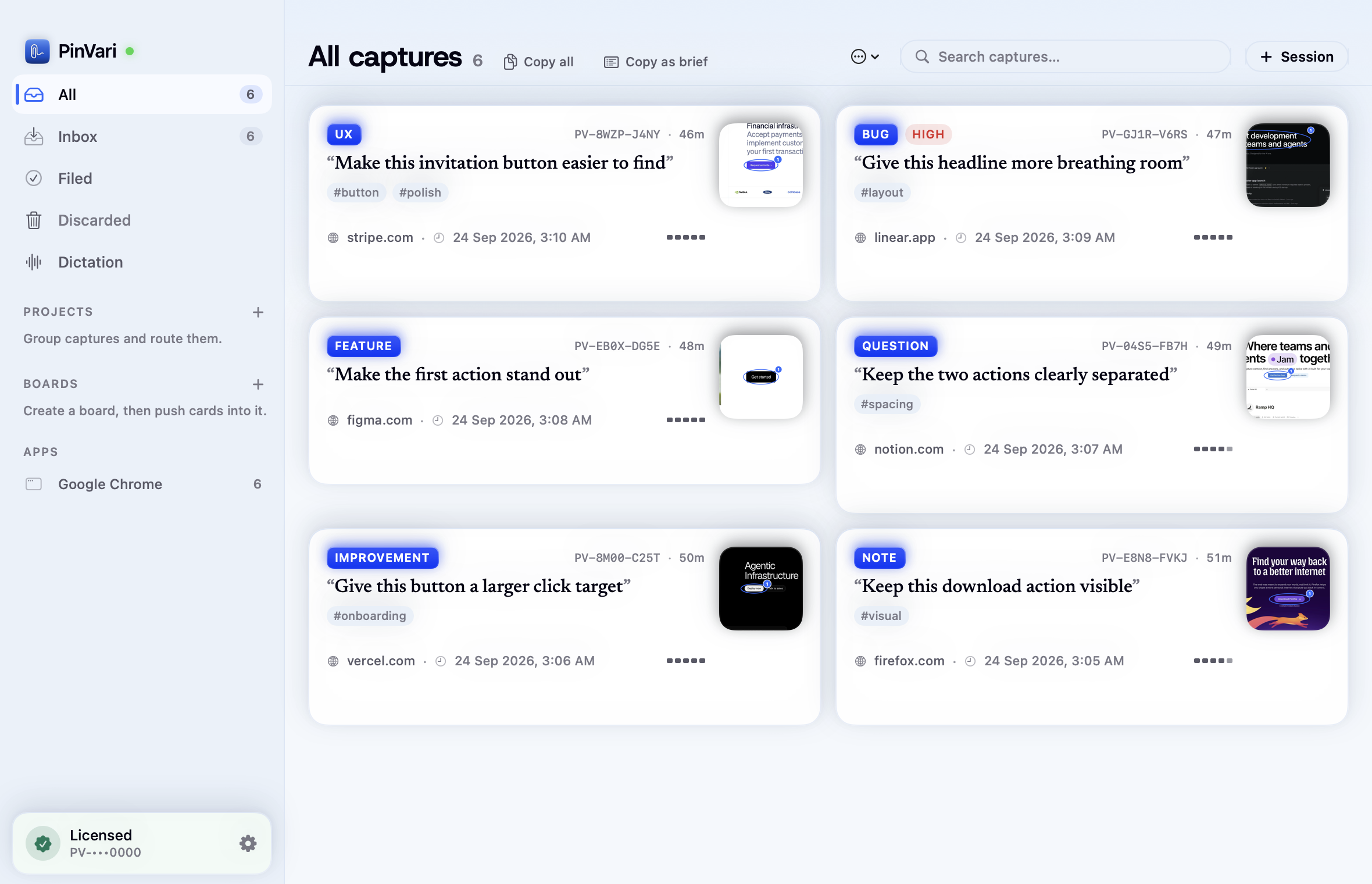
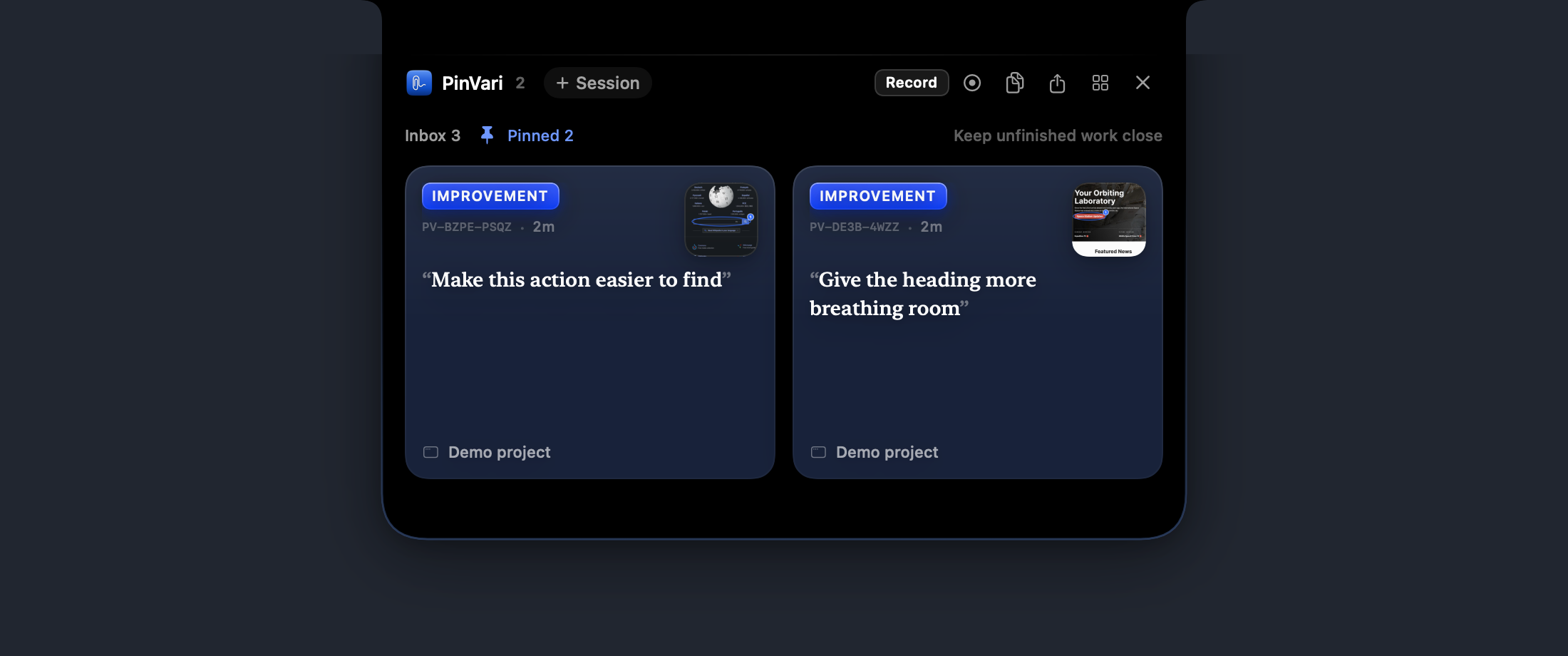
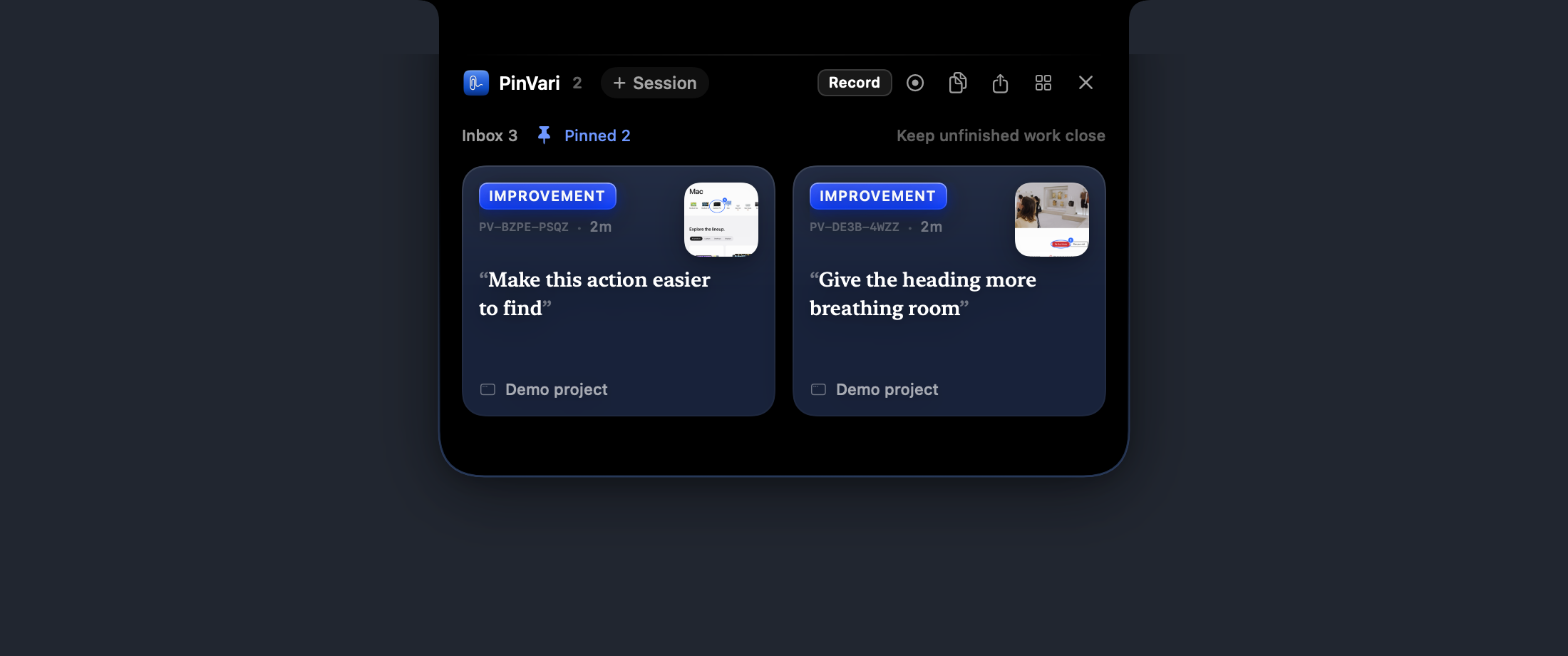
A capture library for everything you notice. A pinned shelf for what you want to finish next. The same workflow in both editions.
Make the feedback
easy to act on.
Select the captures that matter, edit the wording, then export a self-contained HTML Review Pack. The screenshot and instruction stay together, in the order you choose.
- Review what you share before it leaves your Mac.
- Open the exported file in a browser, without a PinVari account.
- Pair before-and-after captures to show what changed.
A visual sample using real website captures and illustrative feedback.
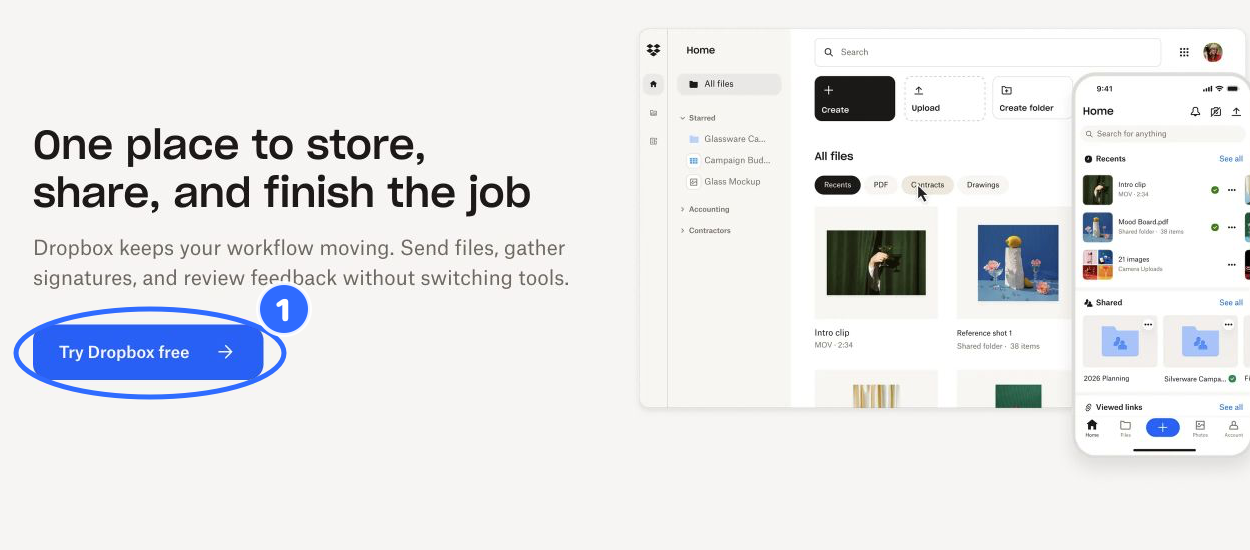
“Make the next step unmistakable.”
Make the card action easier to spot, with clearer contrast and spacing.
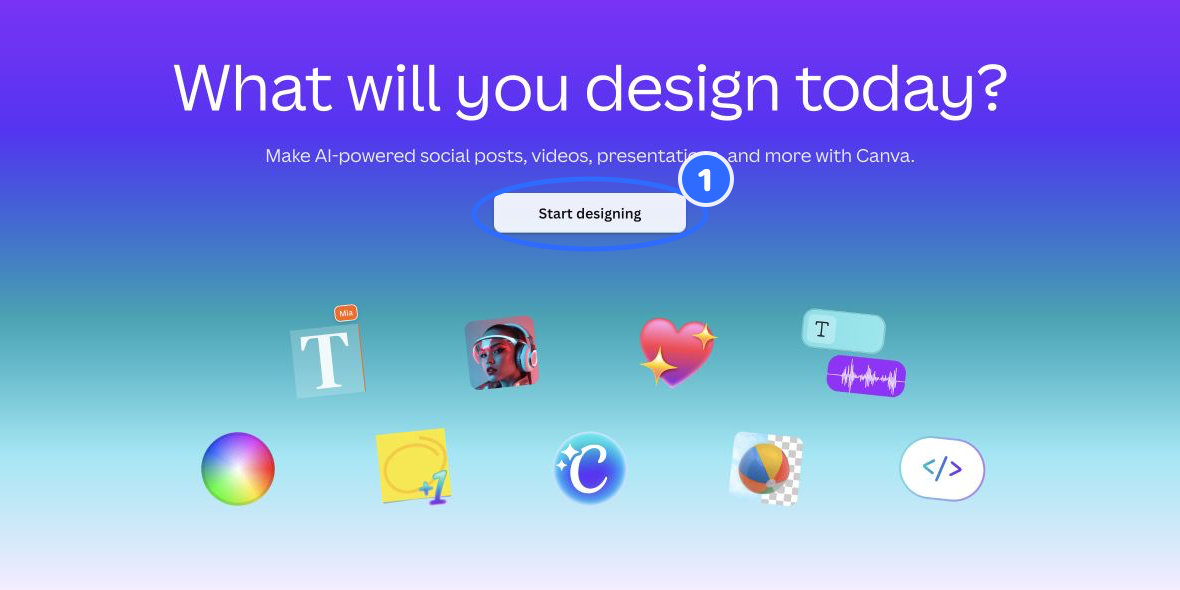
“Make the first action easy to find.”
Keep the design action distinct from the surrounding illustration.
Circle it. Say it. It's saved.
Works on any app — your browser, your editor, a design tool, anything. Just draw around what you mean and talk. No cropping a screenshot, no switching windows, no writing a ticket. Honestly, it's faster than the thought that started it.
- Circle a few things at once — each one gets its own number.
- Say one thing per circle — your words stay pinned to the right spot.
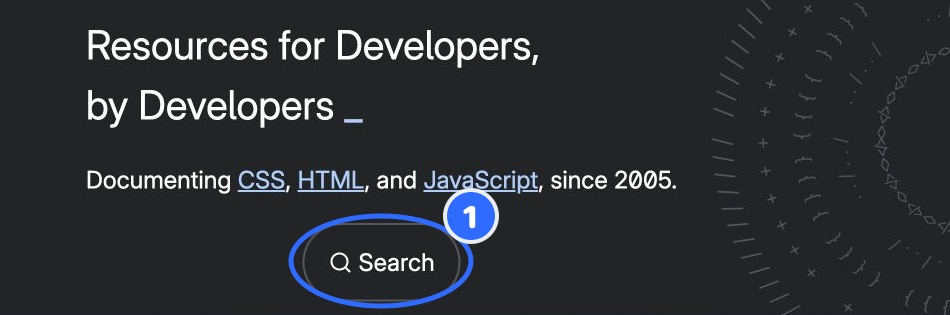
A screenshot shows pixels.
PinVari names the button.
Anyone can send a screenshot and hope the AI figures it out. PinVari does more: it identifies the actual button, field or row you circled — by its real name and role — so your agent isn't guessing at a picture. It knows the exact thing to change. That's the whole point.
- Element names and roles from supported app interfaces.
- Your words, matched to the exact spot you meant.
One tap, and your AI takes it from here.
Every note carries the exact element, your words and the screenshot in one bundle. Tap Copy for agent, or let Claude Code or Cursor pull it in directly — either way, your AI knows exactly what you meant before it writes a single line.
- Connects in one command — nothing else to install.
- Copy a local capture link, or export a Review Pack to share.
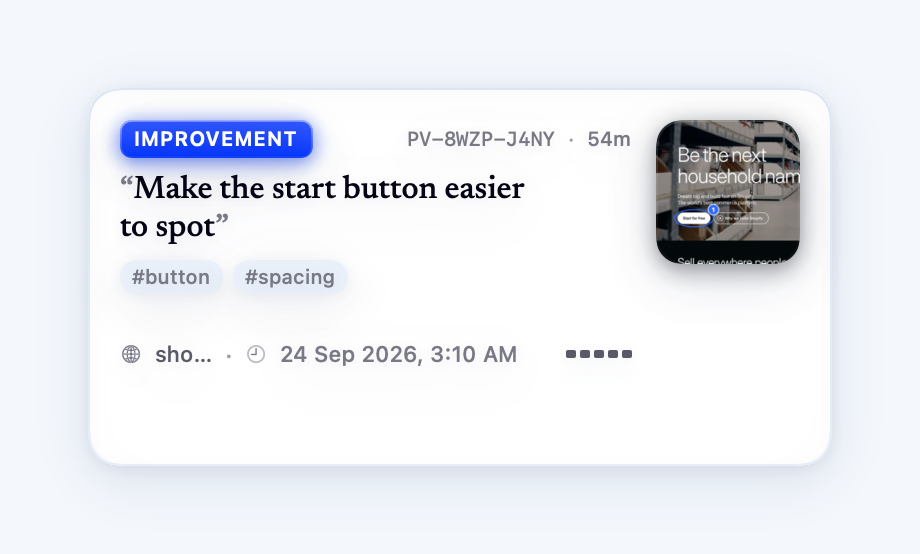
The companion that talks back — and lends a hand.
Max brings the capture tools together with a realtime voice companion. Ask about what’s on your screen, get an on-screen guide, or ask it to help with a task in a supported app. A small companion stays beside your pointer, with visible listening and thinking states.
- Live sessions: leave the mic open and just talk — no hotkey.
- Keep preferences and context in files you can read and edit.
- $29/month · includes 60 minutes of realtime voice per month.
a little company.
Move your cursor. I’m listening.
Everything you'd want. None of the nonsense.
Fast, private, and quiet — it disappears until the second you need it.
Capture transcription stays on your Mac
Point-and-speak capture uses on-device transcription by default. Max’s realtime companion uses cloud AI when you turn it on.
No accounts, no API keys
Nothing to paste, nothing to sign up for. Install it and you're capturing in seconds.
Hides in the notch
It tucks into the one strip of screen you never use — invisible until you hold the key, gone the moment you're done.
Made for Claude Code & Cursor
Connects to the AI agent you already build with — one command, zero setup. Your notes just show up where you need them.
Quick and quiet
Starts on its own, survives restarts, and never gets in your way. You'll forget it's running — until you need it.
Pay once. Keep it forever.
$99, one time. Pro is one payment, forever.
Record a whole workflow
Hit record, work as normal, and PinVari saves a step-by-step trail your agent can follow — as named buttons and fields, not coordinates. Sealed on your Mac, and it never keeps what you type. How it's kept safe →
Installed in one line. Capturing in ten seconds.
Paste one line in your terminal (or grab the .dmg). PinVari sets itself up and connects to your AI agent for you — no config, no keys. Activate your license and start pointing.
$ curl -fsSL https://pinvari.com/install.sh | shOr just remember pinvari.com — the install is on the homepage.
Try the install free. The app connects to your agent with no key. Capturing unlocks the moment you paste your license — buy once, yours forever.
Own it once — or add the companion.
Choose Pro for capture, workflows and hand-off with one payment. Choose Max for those tools plus a cloud voice companion at $29/month. Or try five captures in the App Store edition.
- Point, speak & screenshot capture
- Dashboard + one-paste agent hand-off
- Multi-monitor · several circles per breath
- Fully sandboxed · App Store updates
- On-device transcription, no keys
- Element context · pinned captures · Review Packs
- Workflow recording · dictation · rewrite hotkey
- Live MCP: Claude Code, Cursor & any client
- Teams: $29/seat once · free updates
- 60 realtime voice minutes per month
- Live open-mic sessions & on-screen guides
- Clicks, types, fills forms — with your say-so
- Runs projects with the Claude on your Mac
- Cancel any time — captures stay on-device
Buying for a team? Pro is $29 a seat, one-time — grab seats · volume or invoicing: [email protected]
Every feature. Every tier.
No fine print.
Exactly what each edition does — and doesn't. If a box is empty, that tier really doesn't have it.
Stop typing out bugs. Start pointing at them.
$99, one time. Straight from pinvari.com, notarized for macOS 14+, and working with your AI agent the moment you open it.
The stuff people ask before they hit buy.
Straight answers on what it grabs, where your data goes, and exactly what you pay. No fine print.
What's the difference between Essentials, Pro and Max?
Three honest tiers. PinVari Essentials (free to try, with an in-app unlock, Mac App Store) is the essentials: point, speak, screenshot, dashboard, one-paste hand-off — fully sandboxed. PinVari Pro ($99 once, this site) is the full capture product: every capture resolves the exact named element, plus workflow recording, dictation, the rewrite hotkey and a live MCP connection — the deep integration Apple's sandbox doesn't allow. PinVari Max ($29/month) includes everything in Pro and adds the talking companion: spoken answers, live sessions, on-screen guides, and hands that click, type and build with your say-so. The full sheet shows every line. Essentials and Pro are separate purchases; Max is its own subscription.
Why is Max a subscription when Pro isn't?
Because Max's answers run on cloud AI that costs us money every time it speaks — a one-time price would be dishonest (we'd have to cut you off quietly). Pro’s capture tools run on your Mac; cloud options and your connected AI agent have their own requirements. If you cancel Max, your existing captures stay on your Mac; paid Max features follow your subscription access.
What does it actually grab?
Circle anything on your screen and talk. PinVari grabs a screenshot, figures out the exact button or field you circled (not just the pixels), turns your voice into text right on your Mac, and keeps your words tied to the right spot. The result is one neat note your AI agent can pull in — with everything it needs to make the change.
Is my screen and voice private?
Point-and-speak capture is transcribed on your Mac by default. You choose what to send to your AI agent or include in a Review Pack. Max’s realtime voice and planning use cloud AI, and screen context may be sent to answer your request. Max requires an account; Pro capture does not. See our privacy policy for details.
How hard is it to hook up to my AI?
It's one command. That connects PinVari to Claude Code, Cursor, Codex or any MCP client — then you just tell your agent "use PinVari to see what I mean," and it pulls your note in. That's the whole setup.
Will it run on my Mac?
If you're on macOS 14 (Sonoma) or newer, yes — Apple Silicon or Intel, one app for both. It works whether or not your Mac has a notch.
Does it read more than the screenshot?
Yes. Alongside the screenshot, PinVari reads the full text of the window you captured — up to 40,000 characters, including text scrolled out of view — plus a map of its buttons and fields, the browser's real URL, and on-device OCR as a fallback. Your agent gets the whole stack trace, not the three lines that fit on screen. The nuts and bolts are on the MCP reference page.
Does it work with more than one monitor?
Yes. Every mark remembers which display it was drawn on and the screenshot is taken from that exact monitor, so one capture can span several screens. You can also circle several things in one breath — each mark keeps its own slice of your words.
Can my AI agent ask me to point at something?
Yes — it works both ways. Mid-task your agent can ask you to show it something: PinVari's island lights up asking you to point, you circle the thing and speak, and the capture flows back to the agent automatically. And the agent can never take a screenshot on its own — capture only happens when you hold the hotkey.
Is it really pay-once — no subscription?
For Essentials and Pro — really. $99 one time for Pro, Essentials is free to try with an in-app unlock, teams pay $29 a seat once. No monthly bill, no login. The only subscription in the family is Max at $29/month, because its spoken answers run on cloud AI — and you can cancel it any time without losing your on-device captures.
Still have a question? [email protected]